X-ray gap leaves Ōtorohanga whānau travelling
MEDIA STATEMENT
FOR IMMEDIATE RELEASE
Thursday 17 September 2026, 10:00AM
2 minutes to Read
For whānau in Ōtorohanga, accessing healthcare can mean travelling an hour or more out of town, finding the money for fuel and taking time away from work and whānau.
A new 68-page report from Te Tiratū Iwi Māori Partnership Board finds that limited access to diagnostic and specialist services, combined with transport and cost-of-living pressures, is making it harder for some whānau to access care when they need it.
The Ōtorohanga Hauora Report is the latest in the Hauora Report Series by Te Tiratū examining health across localities in the Tainui waka rohe. While Ōtorohanga has primary healthcare and a strong network of community support, the report identifies significant gaps in services beyond basic care.
One of the clearest gaps is access to diagnostic services, with the distance and cost of travelling for an X-ray or other imaging making it harder for whānau to get care when they need it.
“Because we don’t have medical services like X-rays and diagnostic imaging in Ōtorohanga, whānau have had to go to either Waikato Hospital, which is an hour away and quite expensive for them, or they go to Te Awamutu or Te Kūiti Hospital if they’re able to get appointments,” says longtime local and Te Tiratū Tumu Whakarae, Brandi Hudson.
“As soon as kaumātua have to travel, that’s a real big issue.” For whānau without reliable transport, the challenge is even greater. “Young Māmā need a lot of wraparound support with transport.”
The report finds that these practical challenges can lead to whānau delaying care until they are unwell, rather than having symptoms checked sooner.
That is particularly concerning as the community experiences increasing pressure from long-term conditions, including diabetes, alongside reduced access to some visiting specialist services.
“We’ve seen an increase in diabetes and at the same time we’ve seen a decrease in podiatrists able to come to the community,” she says.
The cost of accessing healthcare is also significant for whānau already managing household financial pressures. The median personal income for Māori aged 30 to 64 in Ōtorohanga is $45,100 compared with $48,700 nationally for Māori in the same age group.
Hudson says the financial pressure is increasingly visible in the community.
“One of the major signs we’re experiencing at the moment is that many whānau are turning up for the food banks, and we were very concerned about hiding in the background is a lot of stress from the rise in the cost of living like fuel costs that have been really difficult.”
The report also identifies gaps in mental health and alcohol and other drug (AOD) services. Specialist treatment is often delivered outside Ōtorohanga, while post-treatment pathways are limited and support can reduce once people no longer meet eligibility thresholds.
For Te Tiratū Iwi Maori Partnership Board, the findings point to the need for healthcare solutions that reflect the realities of rural communities rather than expecting whānau to overcome distance, cost and transport barriers themselves.
The report calls for:
- Dedicated 0.6 to 1.0 FTE diabetes and long-term condition support based in Ōtorohanga
- Diagnostic transport support bundled with referrals
- Weekly mobile imaging service in Ōtorohanga to restore access to diagnostic imaging
- Mobile ultrasound clinic operating in Ōtorohanga
- Permanent alcohol and other drugs clinician based in Ōtorohanga
- Funded six- to 12-month structured relapse-prevention follow-up for people receiving AOD treatment
- Funded transport vouchers for young Māmā.
Hudson says Ōtorohanga has significant strengths, including strong community connections and people who continue to support one another.
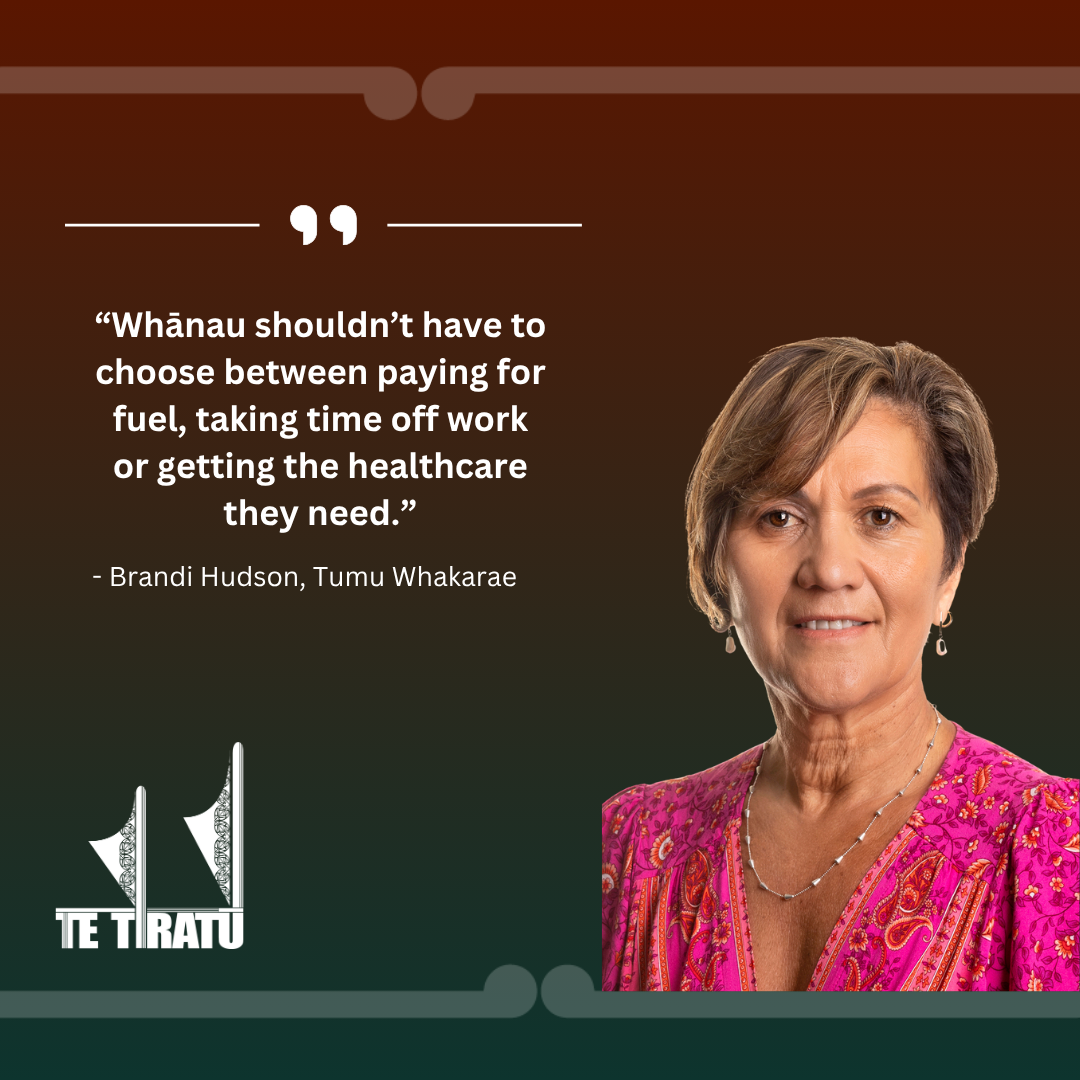
“Ōtorohanga is a very well-supported community by its own people. But we need a health system that recognises the realities of rural life. Whānau shouldn’t have to choose between paying for fuel, taking time off work or getting the healthcare they need. Bringing more services closer to home would make a real difference.”
This edition is one of ten locality Hauora Reports being developed by Te Tiratū across the Tainui waka rohe. The reports combine local health data with insights gathered through the Whānau Voice engagement programme to identify the health priorities, barriers and strengths of each community.
For Ōtorohanga, the report highlights how distance from essential diagnostics and specialist care can become a health barrier in itself.

Making healthcare easier for Te Awamutu whānau
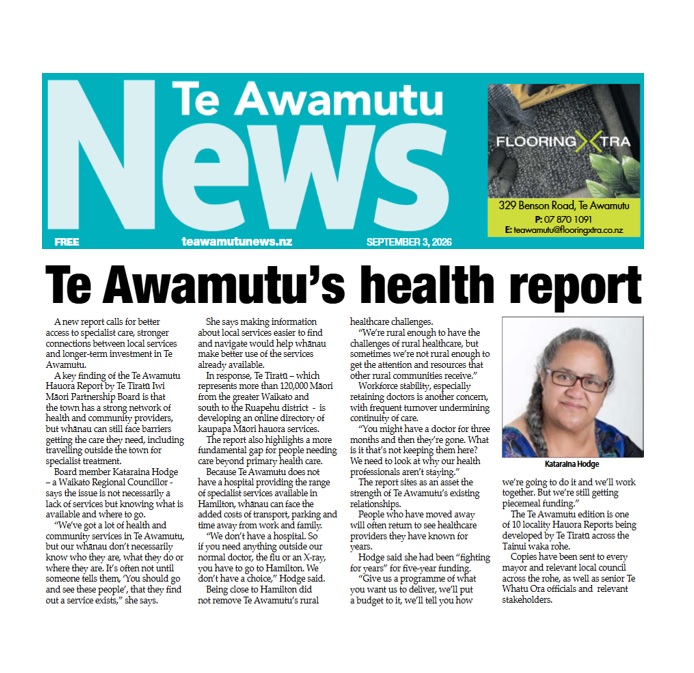
Te Awamutu News has highlighted the findings of our Te Awamutu Hauora Report, which looks at what’s working well for whānau and where more support is needed.
Te Tiratū Iwi Māori Partnership Board member Kataraina Hodge says Te Awamutu has many health and community services, but whānau don’t always know what is available or where to go.
That’s why Te Tiratū is developing an online directory of kaupapa Māori hauora services, making it easier for whānau to find the right support.
The report also highlights the challenges of travelling to Hamilton for specialist care, including the extra costs of petrol, parking and time away from work and whānau.
For Te Tiratū, whānau need healthcare that is accessible, connected and responsive to the needs of our communities.
The Te Awamutu report is one of 10 locality Hauora Reports being developed by Te Tiratū across the Tainui waka rohe, ensuring whānau voices help shape the future of hauora.
Te Awamutu has health services. But can whānau find the care they need?
MEDIA STATEMENT
FOR IMMEDIATE RELEASE
Friday 28 August 2026, 10:00AM
2 minutes to Read
A new report is calling for better access to specialist care, stronger connections between local services and longer-term investment in Te Awamutu.
Te Awamutu has a strong network of health and community providers, but whānau can still face barriers getting the care they need, including travelling outside the town for specialist treatment.
That is a key finding of a new Te Awamutu Hauora Report by Te Tiratū Iwi Māori Partnership Board.
Board member Kataraina Hodge says the issue is not necessarily a lack of services but knowing what is available and where to go.
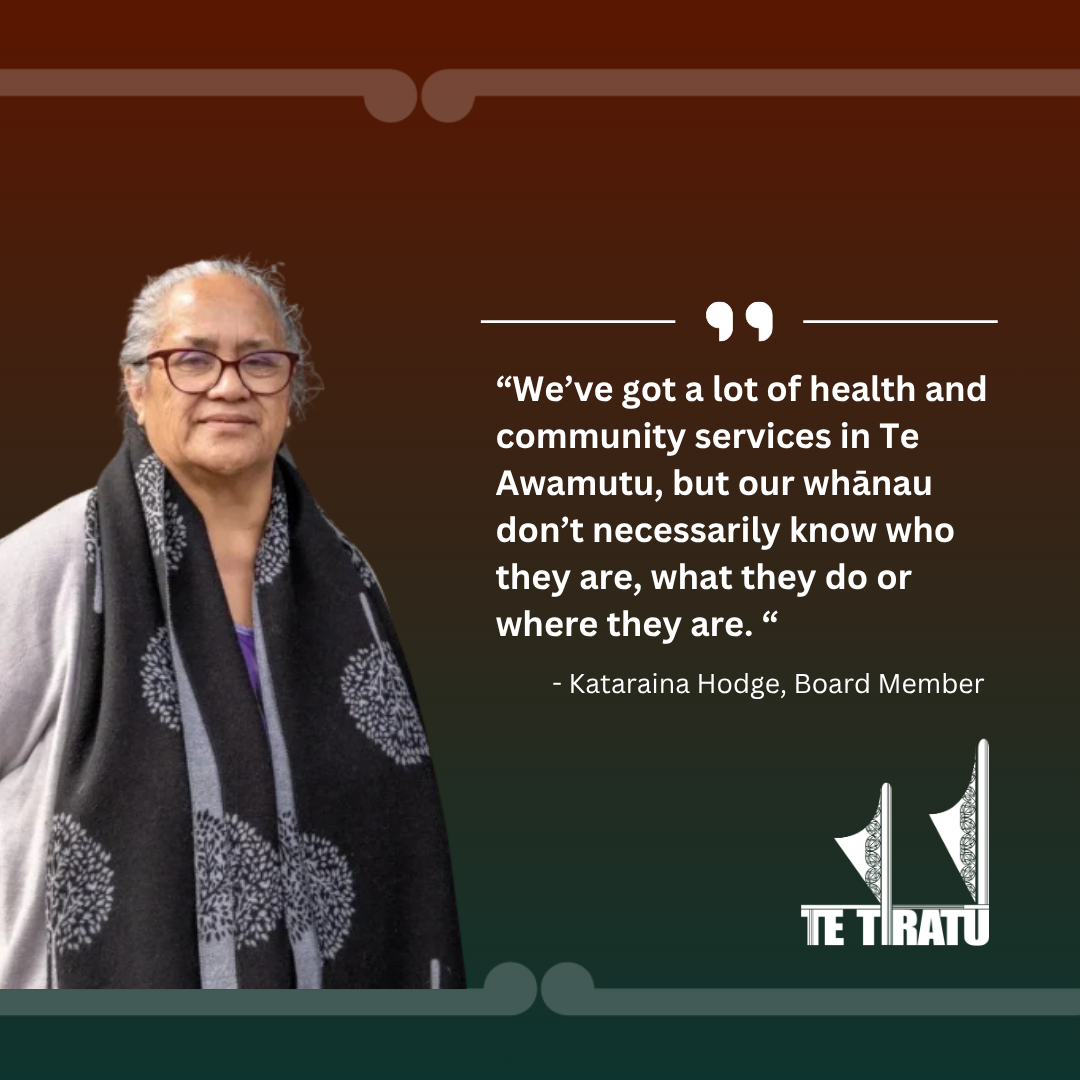
“We’ve got a lot of health and community services in Te Awamutu, but our whānau don’t necessarily know who they are, what they do or where they are. It’s often not until someone tells them, ‘You should go and see these people’, that they find out a service exists,” she says.
She says making information about local services easier to find and navigate would help whānau make better use of the services already available.
To help address the information gap, Te Tiratū is developing an online directory of kaupapa Māori hauora services across the rohe, giving whānau a clearer pathway to the support available in their communities.
The report also highlights a more fundamental gap for people needing care beyond primary health care.
Te Awamutu does not have a hospital providing the range of specialist services available in Hamilton, meaning whānau can face the added costs of transport, parking and time away from work and family.
“We don’t have a hospital. So if you need anything outside our normal doctor, the flu or an X-ray, you have to go to Hamilton. We don’t have a choice.”
Being close to Hamilton does not remove Te Awamutu’s rural healthcare challenges either according to Hodge.
“We’re rural enough to have the challenges of rural healthcare, but sometimes we’re not rural enough to get the attention and resources that other rural communities receive.”
Workforce stability, especially retaining doctors is another concern, with frequent turnover undermining continuity of care.
“You might have a doctor for three months and then they’re gone. What is it that’s not keeping them here? We need to look at why our health professionals aren’t staying.”
The strength of Te Awamutu’s existing relationships is also identified as an asset. People who have moved away will often return to see healthcare providers they have known for years.
“People still want to come home. They want to come home for their doctors because they’ve been here forever. We’ve grown up relying on the person who’s always been there for us.”
The report identifies cost, transport, workforce shortages and poor coordination between services as barriers to timely care. Housing pressures, the rising cost of living and increasing mental health needs can add further pressure for whānau.
The answer is not necessarily to create another layer of services, Hodge says, but to make the existing system work better around the people who use it.
That means stronger primary care, a sustainable workforce, better access to specialist care closer to home, stronger coordination between health and social services, and continued investment in prevention and kaupapa Māori approaches.
Funding is also critical. Short-term and fragmented funding makes it difficult for providers to plan together and build sustainable services.
“I’ve been fighting for years for five-year funding. Give us a programme of what you want us to deliver, we’ll put a budget to it, we’ll tell you how we’re going to do it and we’ll work together. But we’re still getting piecemeal funding.”
“The issue isn’t whether whānau want care. It’s whether the system makes it easy to get it,” she says.
The Te Awamutu edition is one of 10 locality Hauora Reports being developed by Te Tiratū across the Tainui waka rohe. Together, the reports are intended to ensure local voices and experiences inform health planning, investment and decisions about the services communities need.
Copies of the reports have been sent to every mayor and relevant local council across the rohe, as well as senior Te Whatu Ora officials and other relevant stakeholders putting the findings directly in front of those responsible for health planning and local decision-making.
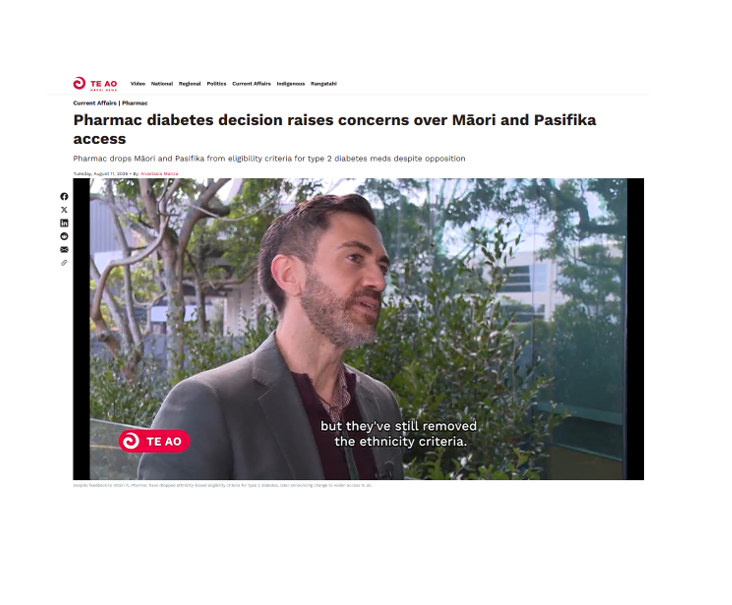
Te Tiratū questions removal of ethnicity criteria for funded type 2 diabetes medicines
Te Tiratū Board member, Dr Mataroria Lyndon speaks to Whakaata Māori about the impact of changes to diabetes medicine access.
Pharmac’s decision to remove Māori and Pasifika-specific eligibility criteria for four type 2 diabetes medicines has raised concerns about whether widening access will translate into equitable access for the people experiencing the greatest burden of diabetes.
Te Tiratū Iwi Māori Partnership Board member Dr Mataroria Lyndon spoke to Whakaata Māori about the decision and the implications for Māori.
From 1 September, access to empagliflozin, empagliflozin with metformin, liraglutide and dulaglutide will be widened to people with type 2 diabetes whose blood sugar remains high despite other treatment. Pharmac says the change will give an additional 31,000 people access to the medicines over five years.
Dr Lyndon says while wider access is positive, a universal approach does not automatically mean Māori and Pasifika will have equal access in practice.
Māori are twice as likely as non-Māori to have diabetes and are also more likely to experience serious complications, including cardiovascular disease, kidney disease and lower-limb amputations.
“Māori are three times more likely than non-Māori to lose their leg or foot,” he said.
Diabetes can contribute to serious complications including cardiovascular disease, kidney disease, vision loss, and amputations.
Te Tiratū believes these concerns cannot be separated from the wider inequities Māori experience across the health system.
“Pharmac needs to demonstrate that removing the ethnicity criteria will not worsen outcomes for Māori. The issue was that even proposing to remove an ethnicity criterion is a breach of Te Tiriti, but it also undermines the need,” said Dr Lyndon.
The concern is that removing targeted eligibility criteria assumes everyone is starting from the same position, despite longstanding inequities in diagnosis, monitoring, treatment, and access to healthcare.
“That’s why we need a targeted response to address it, not a one-size-fits-all approach.”
According to Te Tiratū, the impact of the changes must be closely monitored to ensure Māori are not disadvantaged and that increased eligibility translates into improved access and health outcomes.
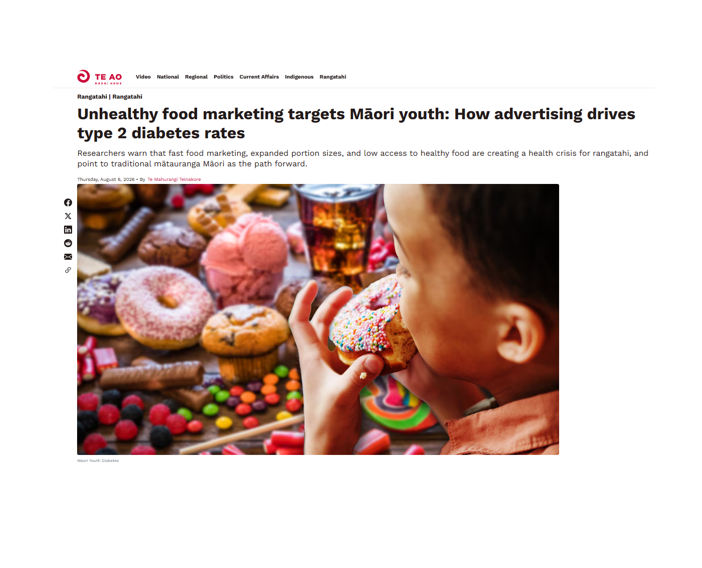
Unhealthy food marketing targets Māori youth: How advertising drives type 2 diabetes rates
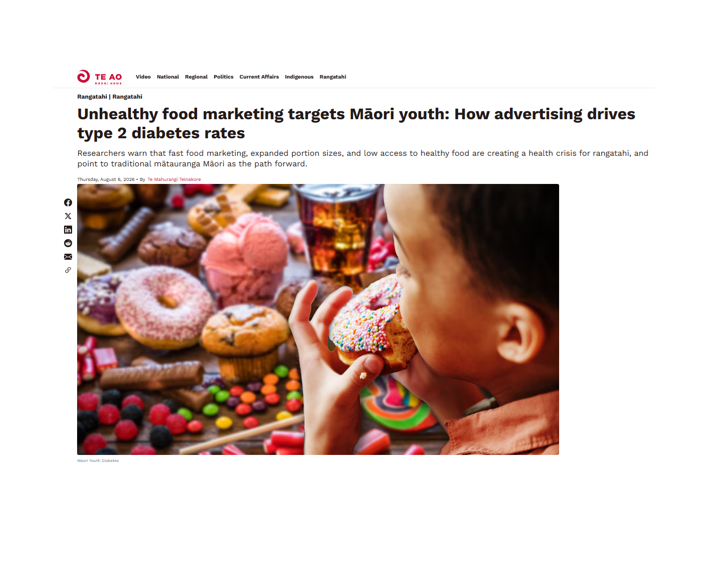
Te Tiratū Iwi Māori Partnership Board member Dr Mataroria Lyndon has spoken to Whakaata Māori about the growing impact of unhealthy food marketing on Māori communities and the links to rising rates of type 2 diabetes.
The interview follows research highlighting how rangatahi are increasingly exposed to fast-food advertising, larger portion sizes and food environments where unhealthy options can be cheaper and easier to access.
Dr Lyndon says the issue cannot simply be reduced to individual choice.
“We know that especially our lower income communities are more targeted with fast food, with that type of marketing.”
He also points to the growing size of meals and the impact this has on what people perceive as a normal portion.
“The portion of our kai is a lot more than we need, and also a lot more calories, a lot more sugars and fat in that kai, so we are eating a lot more than what’s good for us.”
Researchers say Māori continue to experience disproportionately high rates of type 2 diabetes, with many developing the condition at younger ages.
The discussion also highlights the importance of Māori-led approaches to prevention and wellbeing, including reconnecting with traditional kai, mātauranga Māori and the practices of tūpuna that supported healthy communities.
For Te Tiratū the issue reinforces the need to address the wider conditions shaping whānau health and not simply place the responsibility on individuals.
Healthy choices are much harder when the environment around whānau is designed to promote unhealthy ones.

Supporting smokefree and vapefree communities across our rohe
Creating healthier futures for our tamariki, rangatahi and whānau is a shared responsibility. One way we can all contribute is by helping ensure tobacco and vaping laws are followed in our communities.
Health New Zealand has developed a range of resources to help people recognise and report illegal smoking and vaping activity under the Smokefree Environments and Regulated Products Act 1990. By raising concerns when the law is not being followed, communities can help reduce harm and protect future generations from nicotine addiction.
Why this matters for our Tainui waka rohe
Te Tiratū represents more than 121,000 Māori across the Waikato. Despite significant progress in reducing smoking over recent decades, tobacco use continues to have a disproportionate impact on Māori health and contributes to preventable illness, chronic disease and premature mortality.
Nationally, Māori adults are more than twice as likely to smoke daily as the overall population (15.0% compared with 6.8%). Daily vaping is also significantly higher among Māori adults (27.5%), highlighting the importance of supporting evidence-based prevention and cessation initiatives while protecting young people from developing lifelong nicotine dependence.
The picture is particularly important for rangatahi. While youth smoking has declined to historically low levels, vaping remains common among secondary school students, with Māori rangatahi continuing to experience the highest rates. Preventing access to tobacco and vaping products by those under 18 is an important step towards improving long-term health outcomes and reducing inequities experienced by Māori.
Healthy communities are built when tamariki can grow up in environments that support wellbeing, reduce exposure to harmful substances and make healthy choices easier.
What can be reported?
Anyone can report concerns about businesses or individuals who may be breaching New Zealand’s smokefree and vaping legislation, including:
- Selling tobacco or vape products to people under 18 years of age.
- Selling illegally imported or illicit tobacco products.
- Selling prohibited disposable vaping products.
- Displaying or advertising tobacco or vaping products unlawfully.
- Smoking or vaping in smokefree workplaces, restaurants, bars or other regulated public spaces.
- Retailers not complying with the requirements of the Smokefree Environments and Regulated Products Act 1990.
- Community reporting helps Health New Zealand investigate potential breaches, improve compliance and strengthen protections for everyone.
How to make a complaint
If you are concerned about illegal smoking or vaping activity in your community, you can make a report directly here: https://healthnz.govt.nz/TellUs
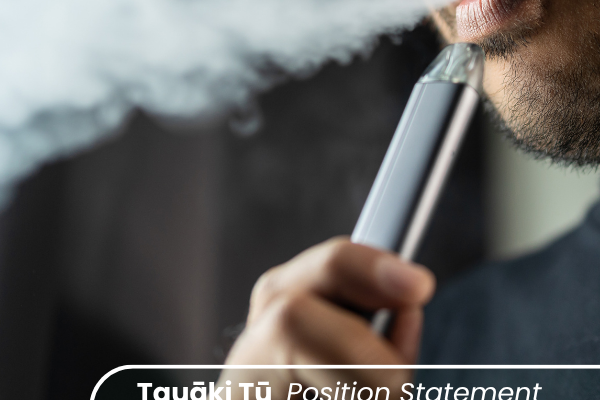
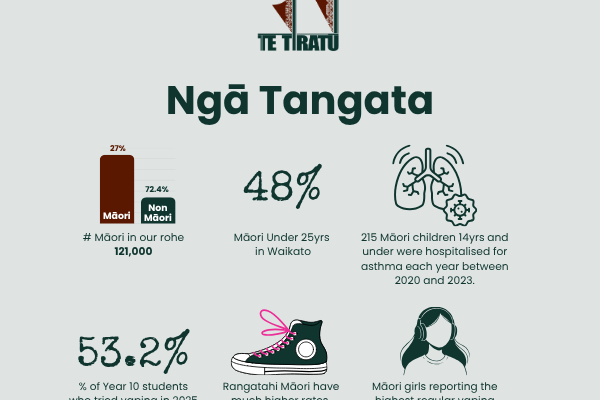
We need to curb the rising uptake of vaping products across the Waikato rohe.

Te Aka Whai Ora may be shut down but Māori health leaders are continuing its work
Te Aka Whai Ora may be gone, but the lessons remain. (Design: Tina Tiller).
Te Tiratū Iwi Māori Partnership Board member Dr Mataroria Lyndon reflects on the enduring importance of Māori leadership in hauora Māori following the disestablishment of Te Aka Whai Ora Māori Health Authority.
In his opinion piece for The Spinoff, Mataroria shares his reflections as a founding board member of Te Aka Whai Ora and considers the lessons from its short but significant journey.
He writes that while the organisation may have ended, the kaupapa of Māori decision-making, equity and whānau-centred health transformation continues through iwi Māori partnership boards, Whānau Ora commissioning agencies, Māori health providers and communities.
Mataroria says the future of hauora Māori must be built on enduring Māori leadership, strong partnerships and decisions made closer to whānau and communities.
Te Kūiti rural healthcare hub strained by rising demand
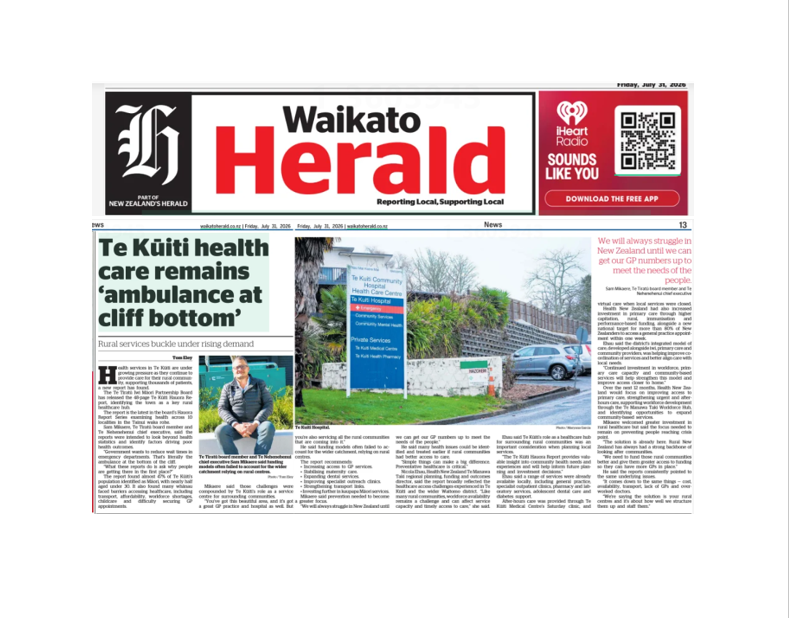
The Waikato Herald has featured the Te Kūiti Hauora Report by Te Tiratū Iwi Māori Partnership Board, highlighting the growing pressure on Te Kūiti’s health services as they support both the local community and surrounding rural areas. The article outlines the report’s findings on barriers to healthcare, including GP shortages, transport, affordability and workforce challenges, along with recommendations to strengthen primary care, maternity, dental and kaupapa Māori services. Health New Zealand said the report provides valuable insight that will help inform future planning for rural health services.
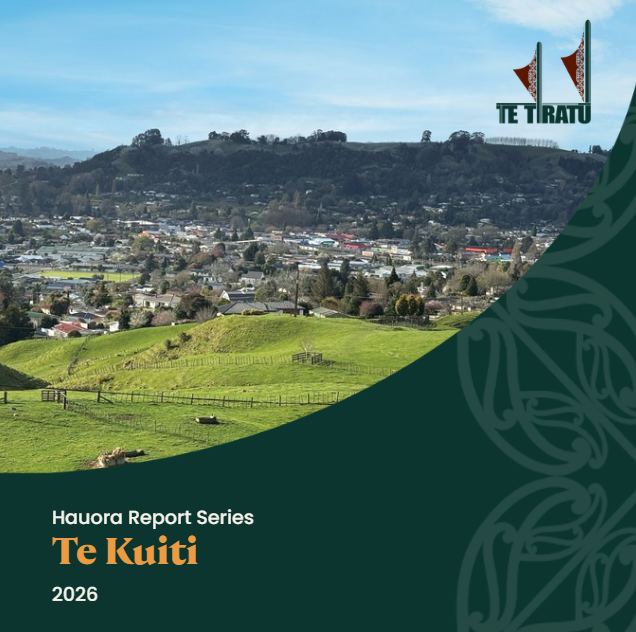
New Te Kūiti Hauora Report reveals mounting pressure on rural ‘health hub’ serving the wider district
MEDIA STATEMENT
FOR IMMEDIATE RELEASE
Monday 13 July 2026, 10:00AM
2 minutes to Read

Te Tiratū Iwi Māori Partnership Board has today released its 48-page Te Kūiti Hauora Report, revealing the growing strain on one of the Waikato region’s key rural health hubs, where local services are supporting not only Te Kūiti residents but whānau from surrounding communities who rely on the town for everyday healthcare.
The report is the latest in the Hauora Report Series by the Iwi Māori Partnership Board examining health across ten localities in the Tainui waka rohe – Taumarunui, Putāruru, Tokoroa, Paeroa, Thames, Te Kūiti, Ōtorohanga, Te Awamutu, Raahui Pookeka and Ngaaruawaahia, and Kirikiriroa.
While every community has its own story, the Te Kūiti report identifies a unique challenge – a comparatively young Māori population combined with the responsibility of delivering healthcare across a much wider rural catchment.
Te Tiratū Board member and Chief Executive of Te Nehenehenui, Sam Mikaere said the report demonstrates why rural communities require different solutions than larger urban centres.
“Te Kūiti isn’t simply providing healthcare for one town. It is a rural service hub carrying the health needs of communities across the wider district. That means pressure on local services is constant, and when capacity is stretched, the effects are felt far beyond Te Kūiti itself.”
Almost 47 percent of Te Kūiti’s population is Māori, with nearly half of residents under the age of 30. At the same time, local providers are managing increasing demand from surrounding communities for GP services, maternity care, dental care and chronic disease management.
Unlike reports that focus solely on health statistics, the Te Kūiti Hauora Report combines the lived experiences of whānau with local health data revealing how transport, cost, workforce shortages, childcare and the availability of appointments influence whether people can access care early or delay treatment until conditions worsen.
The findings Mikaere said point to a straightforward conclusion.
“Te Kūiti doesn’t need the health system redesigned. It needs sustained investment in the local services already carrying the load. When whānau can access care close to home, they stay healthier, avoid unnecessary hospital admissions and the whole system performs better.”
The report found that many whānau experience difficulty enrolling with a GP or securing appointments when they need them. Travel to Hamilton often becomes the alternative, adding cost, time and disruption for families already balancing household expenses.
Providers are also managing sustained demand from long-term conditions including diabetes, asthma, cardiovascular disease and mental health concerns, while high levels of deprivation continue to shape everyday health outcomes.
Rather than proposing new structures, the Te Kūiti Hauora Report calls for practical investment in the services already supporting whānau, including:
• Greater access to primary care and GP services.
• Stable local maternity services.
• Expanded dental care.
• More specialist outreach clinics.
• Better transport connections for rural communities.
• Stronger kaupapa Māori services and whānau navigation.
The report also calls for Ngāti Maniapoto to be genuine partners in designing and leading health services, recognising that locally informed solutions produce better outcomes for whānau.
“Decisions about rural healthcare must reflect how rural communities actually live. The evidence shows that when services are local, accessible and designed with communities, people receive care earlier and health outcomes improve,” he said.
All the Hauora Reports combine population health data with insights from the Whānau Voice engagement programme run by Te Tiratū Iwi Māori Partnership Board out in the community to inform future health planning and investment.
Each edition in the series reflects the unique health challenges, strengths and aspirations of its community, recognising that no two localities experience healthcare in the same way.
Waikato Hospital ED death prompts iwi call for urgent action
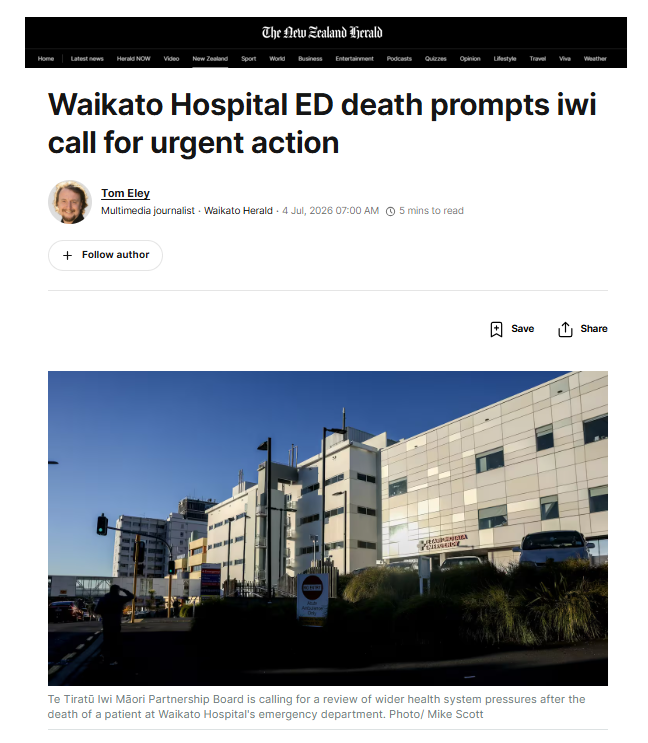
In an interview with the NZ Herald, Te Tiratū Iwi Māori Partnership Board has called for urgent, system-wide action following the death of a patient at Waikato Hospital’s emergency department after a reported nine-hour wait.
The patient was found unresponsive in a waiting room toilet and could not be revived.
Te Tiratū says the incident reflects escalating, hospital-wide pressures rather than an isolated failure, including “access block,” staff shortages, and lack of inpatient beds causing flow breakdown across the system.
Board member Dr Mataroria Lyndon said the tragedy has deeply affected whānau, witnesses, and staff, and highlighted moral injury among clinicians working under sustained pressure.
Co-chair Glen Tupuhi said the review must go beyond the single incident to address wider system failures, including ED congestion, ambulance delays, and hospital capacity issues.
Health New Zealand has launched both an immediate clinical review and a full Serious Adverse Event Review.