
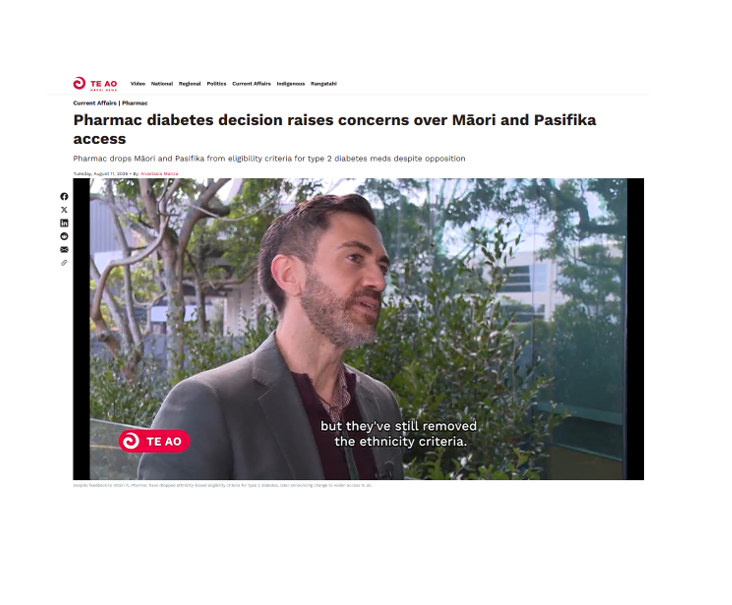
Te Tiratū Board member, Dr Mataroria Lyndon speaks to Whakaata Māori about the impact of changes to diabetes medicine access.
Pharmac’s decision to remove Māori and Pasifika-specific eligibility criteria for four type 2 diabetes medicines has raised concerns about whether widening access will translate into equitable access for the people experiencing the greatest burden of diabetes.
Te Tiratū Iwi Māori Partnership Board member Dr Mataroria Lyndon spoke to Whakaata Māori about the decision and the implications for Māori.
From 1 September, access to empagliflozin, empagliflozin with metformin, liraglutide and dulaglutide will be widened to people with type 2 diabetes whose blood sugar remains high despite other treatment. Pharmac says the change will give an additional 31,000 people access to the medicines over five years.
Dr Lyndon says while wider access is positive, a universal approach does not automatically mean Māori and Pasifika will have equal access in practice.
Māori are twice as likely as non-Māori to have diabetes and are also more likely to experience serious complications, including cardiovascular disease, kidney disease and lower-limb amputations.
“Māori are three times more likely than non-Māori to lose their leg or foot,” he said.
Diabetes can contribute to serious complications including cardiovascular disease, kidney disease, vision loss, and amputations.
Te Tiratū believes these concerns cannot be separated from the wider inequities Māori experience across the health system.
“Pharmac needs to demonstrate that removing the ethnicity criteria will not worsen outcomes for Māori. The issue was that even proposing to remove an ethnicity criterion is a breach of Te Tiriti, but it also undermines the need,” said Dr Lyndon.
The concern is that removing targeted eligibility criteria assumes everyone is starting from the same position, despite longstanding inequities in diagnosis, monitoring, treatment, and access to healthcare.
“That’s why we need a targeted response to address it, not a one-size-fits-all approach.”
According to Te Tiratū, the impact of the changes must be closely monitored to ensure Māori are not disadvantaged and that increased eligibility translates into improved access and health outcomes.