
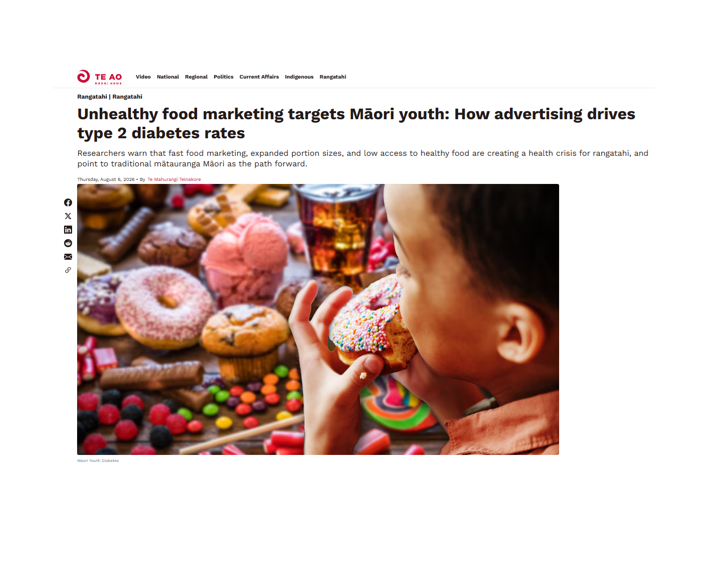
Te Tiratū Iwi Māori Partnership Board member Dr Mataroria Lyndon has spoken to Whakaata Māori about the growing impact of unhealthy food marketing on Māori communities and the links to rising rates of type 2 diabetes.
The interview follows research highlighting how rangatahi are increasingly exposed to fast-food advertising, larger portion sizes and food environments where unhealthy options can be cheaper and easier to access.
Dr Lyndon says the issue cannot simply be reduced to individual choice.
“We know that especially our lower income communities are more targeted with fast food, with that type of marketing.”
He also points to the growing size of meals and the impact this has on what people perceive as a normal portion.
“The portion of our kai is a lot more than we need, and also a lot more calories, a lot more sugars and fat in that kai, so we are eating a lot more than what’s good for us.”
Researchers say Māori continue to experience disproportionately high rates of type 2 diabetes, with many developing the condition at younger ages.
The discussion also highlights the importance of Māori-led approaches to prevention and wellbeing, including reconnecting with traditional kai, mātauranga Māori and the practices of tūpuna that supported healthy communities.
For Te Tiratū the issue reinforces the need to address the wider conditions shaping whānau health and not simply place the responsibility on individuals.
Healthy choices are much harder when the environment around whānau is designed to promote unhealthy ones.