Making healthcare easier for Te Awamutu whānau
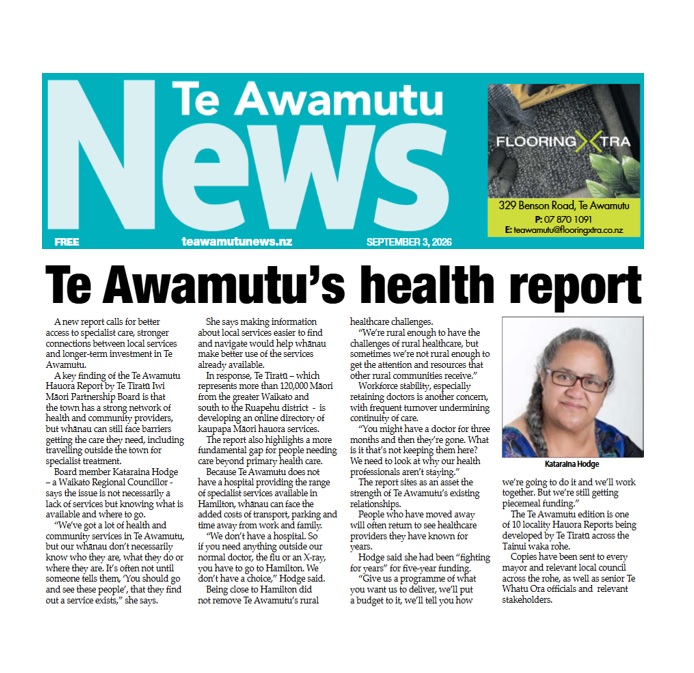
Te Awamutu News has highlighted the findings of our Te Awamutu Hauora Report, which looks at what’s working well for whānau and where more support is needed.
Te Tiratū Iwi Māori Partnership Board member Kataraina Hodge says Te Awamutu has many health and community services, but whānau don’t always know what is available or where to go.
That’s why Te Tiratū is developing an online directory of kaupapa Māori hauora services, making it easier for whānau to find the right support.
The report also highlights the challenges of travelling to Hamilton for specialist care, including the extra costs of petrol, parking and time away from work and whānau.
For Te Tiratū, whānau need healthcare that is accessible, connected and responsive to the needs of our communities.
The Te Awamutu report is one of 10 locality Hauora Reports being developed by Te Tiratū across the Tainui waka rohe, ensuring whānau voices help shape the future of hauora.

Te Awamutu has health services. But can whānau find the care they need?
MEDIA STATEMENT
FOR IMMEDIATE RELEASE
Friday 28 August 2026, 10:00AM
2 minutes to Read
A new report is calling for better access to specialist care, stronger connections between local services and longer-term investment in Te Awamutu.
Te Awamutu has a strong network of health and community providers, but whānau can still face barriers getting the care they need, including travelling outside the town for specialist treatment.
That is a key finding of a new Te Awamutu Hauora Report by Te Tiratū Iwi Māori Partnership Board.
Board member Kataraina Hodge says the issue is not necessarily a lack of services but knowing what is available and where to go.
“We’ve got a lot of health and community services in Te Awamutu, but our whānau don’t necessarily know who they are, what they do or where they are. It’s often not until someone tells them, ‘You should go and see these people’, that they find out a service exists,” she says.
She says making information about local services easier to find and navigate would help whānau make better use of the services already available.
To help address the information gap, Te Tiratū is developing an online directory of kaupapa Māori hauora services across the rohe, giving whānau a clearer pathway to the support available in their communities.
The report also highlights a more fundamental gap for people needing care beyond primary health care.
Te Awamutu does not have a hospital providing the range of specialist services available in Hamilton, meaning whānau can face the added costs of transport, parking and time away from work and family.
“We don’t have a hospital. So if you need anything outside our normal doctor, the flu or an X-ray, you have to go to Hamilton. We don’t have a choice.”
Being close to Hamilton does not remove Te Awamutu’s rural healthcare challenges either according to Hodge.
“We’re rural enough to have the challenges of rural healthcare, but sometimes we’re not rural enough to get the attention and resources that other rural communities receive.”
Workforce stability, especially retaining doctors is another concern, with frequent turnover undermining continuity of care.
“You might have a doctor for three months and then they’re gone. What is it that’s not keeping them here? We need to look at why our health professionals aren’t staying.”
The strength of Te Awamutu’s existing relationships is also identified as an asset. People who have moved away will often return to see healthcare providers they have known for years.
“People still want to come home. They want to come home for their doctors because they’ve been here forever. We’ve grown up relying on the person who’s always been there for us.”
The report identifies cost, transport, workforce shortages and poor coordination between services as barriers to timely care. Housing pressures, the rising cost of living and increasing mental health needs can add further pressure for whānau.
The answer is not necessarily to create another layer of services, Hodge says, but to make the existing system work better around the people who use it.
That means stronger primary care, a sustainable workforce, better access to specialist care closer to home, stronger coordination between health and social services, and continued investment in prevention and kaupapa Māori approaches.
Funding is also critical. Short-term and fragmented funding makes it difficult for providers to plan together and build sustainable services.
“I’ve been fighting for years for five-year funding. Give us a programme of what you want us to deliver, we’ll put a budget to it, we’ll tell you how we’re going to do it and we’ll work together. But we’re still getting piecemeal funding.”
“The issue isn’t whether whānau want care. It’s whether the system makes it easy to get it,” she says.
The Te Awamutu edition is one of 10 locality Hauora Reports being developed by Te Tiratū across the Tainui waka rohe. Together, the reports are intended to ensure local voices and experiences inform health planning, investment and decisions about the services communities need.
Copies of the reports have been sent to every mayor and relevant local council across the rohe, as well as senior Te Whatu Ora officials and other relevant stakeholders putting the findings directly in front of those responsible for health planning and local decision-making.

Te Kūiti rural healthcare hub strained by rising demand
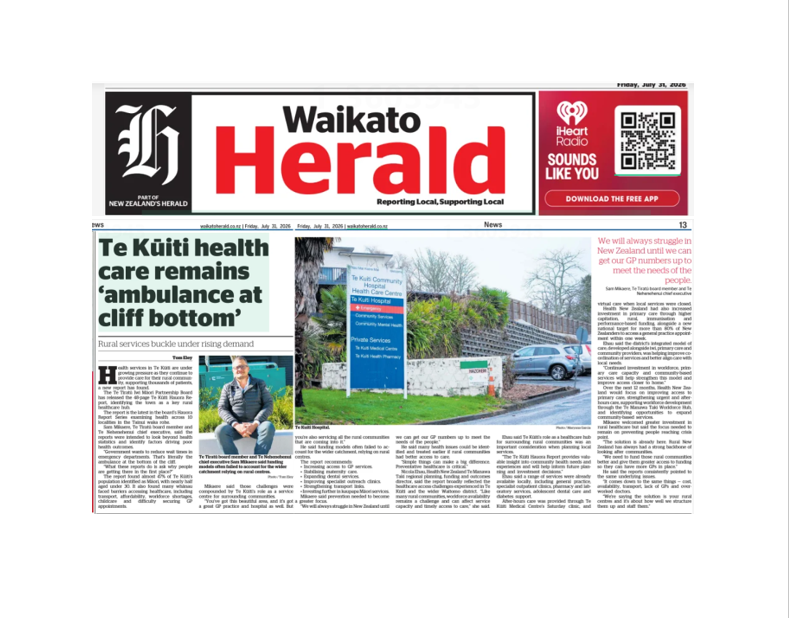
The Waikato Herald has featured the Te Kūiti Hauora Report by Te Tiratū Iwi Māori Partnership Board, highlighting the growing pressure on Te Kūiti’s health services as they support both the local community and surrounding rural areas. The article outlines the report’s findings on barriers to healthcare, including GP shortages, transport, affordability and workforce challenges, along with recommendations to strengthen primary care, maternity, dental and kaupapa Māori services. Health New Zealand said the report provides valuable insight that will help inform future planning for rural health services.
Report raises alarm over strain on rural healthcare
Waatea has spoken with Te Nehenehenui Chief Executive and Te Tiratū Iwi Māori Partnership Board member Sam Mikaere about a new report revealing growing pressure on healthcare services in Te Kūiti.
The Te Kūiti Hauora Report, released by Te Tiratū Iwi Māori Partnership Board, highlights the challenges facing one of the central North Island’s key rural health hubs, including workforce shortages, limited GP access, transport barriers and rising healthcare costs.
The report describes Te Kūiti as a vital service centre supporting whānau across the wider Waitomo and Maniapoto rohe, with increasing demand placing pressure on local health providers and hospital services.
Sam Mikaere discusses why the report was commissioned and the need for stronger investment in rural health infrastructure, workforce development and Māori-led solutions to improve health outcomes.
The report calls for community-driven approaches that ensure whānau can access quality healthcare closer to home.
Te Kūiti carrying the weight of rural healthcare
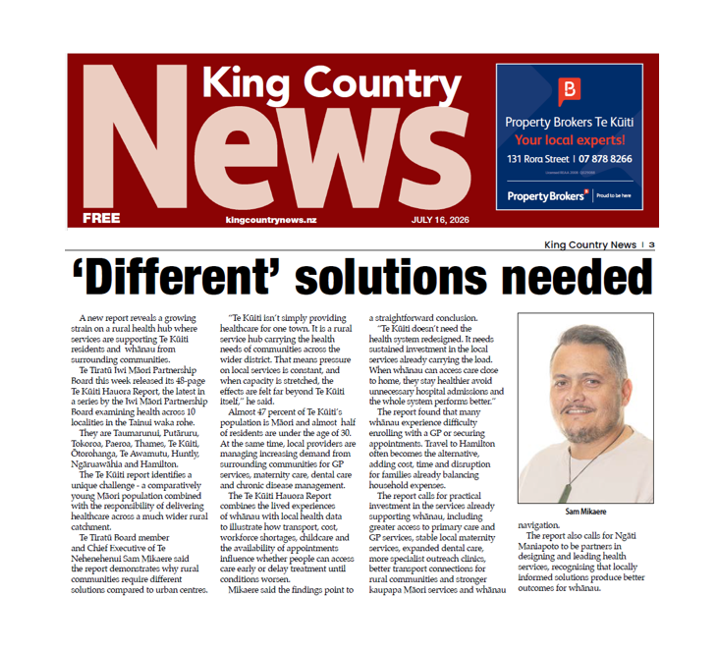
King Country News has featured the first ever Te Kūiti Hauora Report by Te Tiratū Iwi Māori Partnership Board, highlighting the growing pressure on rural health services across the wider district.
The 48-page report examines the health needs of Te Kūiti and surrounding communities, finding that local providers are carrying increasing demand for GP services, maternity care, dental services and chronic disease management while supporting a predominantly rural population.
Drawing on community voices and local health data, the report identifies barriers including workforce shortages, transport, cost, childcare and limited appointment availability, all of which can delay access to healthcare. It calls for sustained investment in primary care, stable maternity services, expanded dental care, more specialist outreach clinics, improved rural transport and stronger kaupapa Māori services and whānau navigation.
Te Tiratū IMPB says practical, locally led investment is essential to ensure whānau can access timely care closer to home and reduce avoidable hospital admissions. The report also recommends that Ngāti Maniapoto be recognised as a partner in the design and delivery of health services to achieve better health outcomes for whānau across the King Country.

New Te Kūiti Hauora Report reveals mounting pressure on rural ‘health hub’ serving the wider district
MEDIA STATEMENT
FOR IMMEDIATE RELEASE
Monday 13 July 2026, 10:00AM
2 minutes to Read

Te Tiratū Iwi Māori Partnership Board has today released its 48-page Te Kūiti Hauora Report, revealing the growing strain on one of the Waikato region’s key rural health hubs, where local services are supporting not only Te Kūiti residents but whānau from surrounding communities who rely on the town for everyday healthcare.
The report is the latest in the Hauora Report Series by the Iwi Māori Partnership Board examining health across ten localities in the Tainui waka rohe – Taumarunui, Putāruru, Tokoroa, Paeroa, Thames, Te Kūiti, Ōtorohanga, Te Awamutu, Raahui Pookeka and Ngaaruawaahia, and Kirikiriroa.
While every community has its own story, the Te Kūiti report identifies a unique challenge – a comparatively young Māori population combined with the responsibility of delivering healthcare across a much wider rural catchment.
Te Tiratū Board member and Chief Executive of Te Nehenehenui, Sam Mikaere said the report demonstrates why rural communities require different solutions than larger urban centres.
“Te Kūiti isn’t simply providing healthcare for one town. It is a rural service hub carrying the health needs of communities across the wider district. That means pressure on local services is constant, and when capacity is stretched, the effects are felt far beyond Te Kūiti itself.”
Almost 47 percent of Te Kūiti’s population is Māori, with nearly half of residents under the age of 30. At the same time, local providers are managing increasing demand from surrounding communities for GP services, maternity care, dental care and chronic disease management.
Unlike reports that focus solely on health statistics, the Te Kūiti Hauora Report combines the lived experiences of whānau with local health data revealing how transport, cost, workforce shortages, childcare and the availability of appointments influence whether people can access care early or delay treatment until conditions worsen.
The findings Mikaere said point to a straightforward conclusion.
“Te Kūiti doesn’t need the health system redesigned. It needs sustained investment in the local services already carrying the load. When whānau can access care close to home, they stay healthier, avoid unnecessary hospital admissions and the whole system performs better.”
The report found that many whānau experience difficulty enrolling with a GP or securing appointments when they need them. Travel to Hamilton often becomes the alternative, adding cost, time and disruption for families already balancing household expenses.
Providers are also managing sustained demand from long-term conditions including diabetes, asthma, cardiovascular disease and mental health concerns, while high levels of deprivation continue to shape everyday health outcomes.
Rather than proposing new structures, the Te Kūiti Hauora Report calls for practical investment in the services already supporting whānau, including:
• Greater access to primary care and GP services.
• Stable local maternity services.
• Expanded dental care.
• More specialist outreach clinics.
• Better transport connections for rural communities.
• Stronger kaupapa Māori services and whānau navigation.
The report also calls for Ngāti Maniapoto to be genuine partners in designing and leading health services, recognising that locally informed solutions produce better outcomes for whānau.
“Decisions about rural healthcare must reflect how rural communities actually live. The evidence shows that when services are local, accessible and designed with communities, people receive care earlier and health outcomes improve,” he said.
All the Hauora Reports combine population health data with insights from the Whānau Voice engagement programme run by Te Tiratū Iwi Māori Partnership Board out in the community to inform future health planning and investment.
Each edition in the series reflects the unique health challenges, strengths and aspirations of its community, recognising that no two localities experience healthcare in the same way.