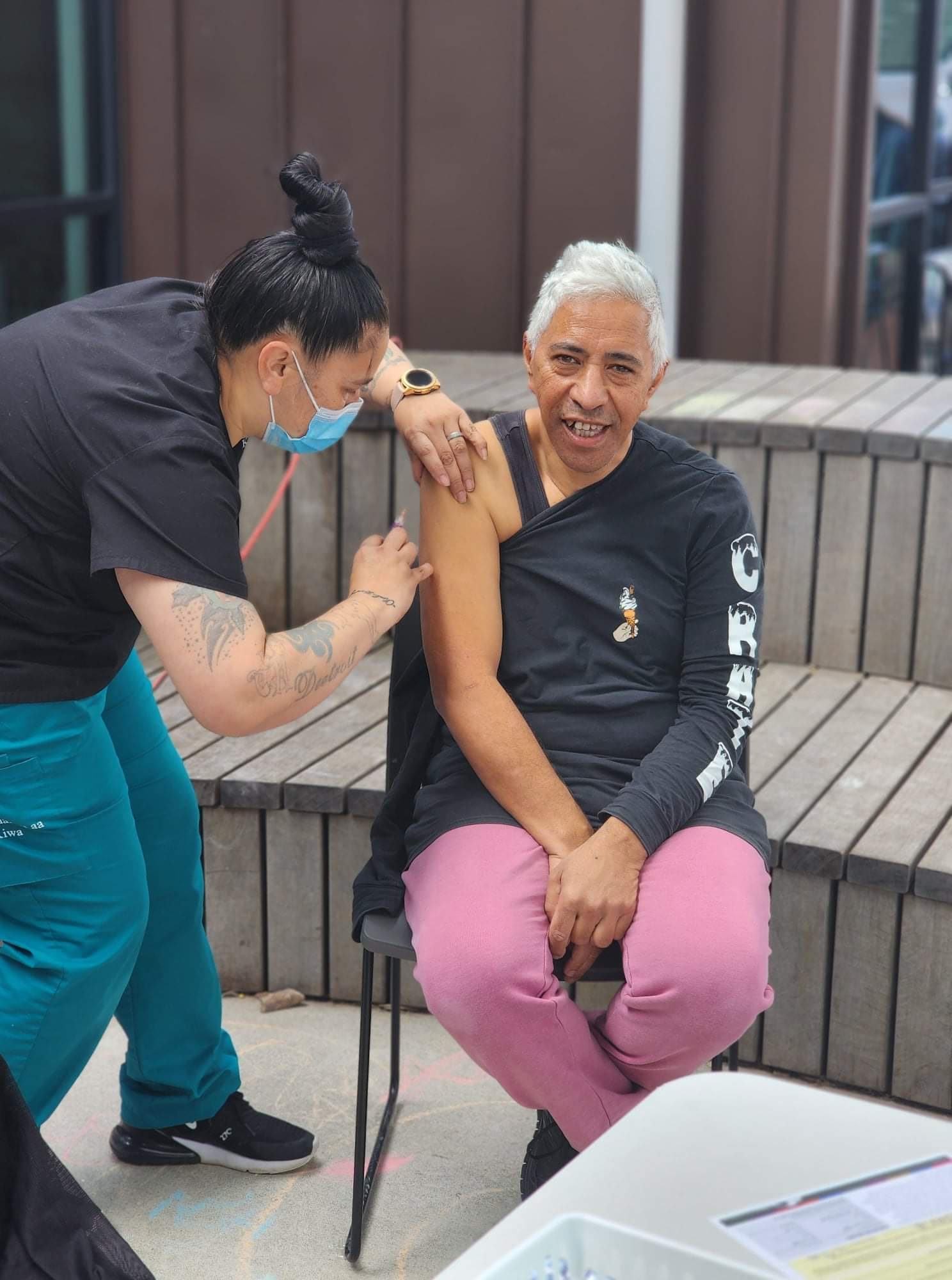
Photo: Terereawai Kipa-Kearns with whānau
When Terereawai Kipa-Kearns (Waikato, Tainui, Ngāti Mahanga, Te Papa o Rotu Marae) asked herself “How do I fix this?”, it wasn’t a casual question—it was the turning point of her life, and a spark that’s now transforming how hauora care is delivered for Māori whānau. Raised in a typical Māori whānau in Ngāruawāhia, Terereawai grew up with reo Māori and from generations on the benefit. She was the first in her whānau to pursue tertiary education, breaking cycles and building new pathways not just for herself, but for generations to come.
She didn’t start her working life in health. In fact, she was a kura kaupapa Māori teacher for more than a decade—after graduating directly from high school into teacher training, then working with both tamariki and adults to uplift reo Māori. But it was the experience of becoming a māmā—specifically her sixth baby—that changed everything.
When her pēpi became seriously ill with bronchiolitis, she found herself in hospital for weeks, grieving the lack of cultural care. “They said I couldn’t breastfeed, couldn’t sleep with my baby, couldn’t make choices that were part of who I am as a Māori māmā. My baby cried. I cried. We just cried together.”
In the middle of one of those long nights in the hospital, she googled: how to become a nurse. The next morning, she told her husband her plan. He said, “Okay.”
From Classroom to Clinic
Terereawai began nursing training a week after her pēpi turned one. Ten years later, she’s still in the thick of it—now a nurse prescriber, nearing the completion of her Master’s degree, and preparing to step into the highly specialised role of nurse practitioner, one of 66 Māori in that field across Aotearoa which is 9% out of a cohort of 703.
Her path hasn’t been typical. In fact, everything about her mahi is designed to flip the Western health system on its head.
“I started thinking I’d go into hospitals and fix things. But during my nursing training, I realised—I’m never working in a hospital. That system’s broken. I fell in love with mental health instead.”
Why mental health? Because it’s complex. Challenging. Not something that can be “solved” with a simple script. “Helping someone find their way back to wellness—that’s rewarding,” she says.
A New Model of Care, Built from the Ground Up
Seeing gaps became part of her superpower. From community mental health, to child and adolescent support, to COVID response leadership—Terereawai saw firsthand how the existing system failed whānau. “Every time I thought I’d removed a barrier, another would appear.”
This motivated her to become a community prescriber, then a designated prescriber, extending her clinical scope to treat whānau with long-term conditions like diabetes and hypertension—especially when they couldn’t afford or access a GP.
But the real shift came when she realised: she couldn’t do what was needed under someone else’s rules. “I kept getting told no—by people who weren’t clinical. They didn’t see the need.”
So, she founded her own charitable trust: Te Ngakau-aa-Kiwa. Now, she and her team deliver wraparound hauora care on whānau terms.
Whānau-First Healthcare
At Te Ngakau-aa-Kiwa, the model is simple: go to the people, not the other way around.
- Home-based care, not clinic-only appointments
- Flexible hours, including evenings and weekends
- Cultural safety, always
- Health prevention and literacy, not just treatment
- Whānau-led solutions, not system-driven ones
“Western models of care don’t work for our whānau,” Terereawai says. “Expecting someone to take time off work, find transport, and get to a GP during office hours—how is that realistic?”
As Clinical Director, she and her team adapt their hours to suit the needs of the people. Mondays, Wednesdays, and Fridays are late-night days. Tuesdays and Thursdays are dedicated to kaumātua day programmes. They see whānau when they need to be seen—early mornings, weekends, whatever it takes.
And the kaupapa works. “We’re seeing real shifts. Because this mahi honours people’s time, their lives, and their tikanga.”
Changing the System, One Whānau at a Time
Even as a nurse prescriber, she sees barriers. “I can treat a sore ear—but if I find something undiagnosed, I still can’t do anything. That’s why I’m becoming a nurse practitioner.”
As a nurse practitioner, Terereawai is the nurse equivalent to a GP. She’ll be able to assess, diagnose, treat, and prescribe—all from inside a whānau home, without them ever stepping into a clinic. That autonomy is rare. Even rarer among Māori.
“In the last three years of postgraduate papers, I’ve been the only Māori in my classes. Out of 80 students.”
That reality drives her every day—to encourage more Māori into health careers, to push for equity in training and workforce development, and to create a new generation of Māori health professionals who are community-rooted and clinically empowered.
“Fixing It” Her Way
What started with one crying mother and a baby in a hospital bed has grown into a movement. A kaupapa. A vision of hauora that centres Māori solutions, Māori leadership, and Māori care.
And she’s not finished yet.
“As soon as I walk into that whānau’s home, I want to be able to do something. Not refer them. Not wait. Just fix it. That’s what this is all about.”
Mauri ora, Terereawai. You’re exactly what our hauora system needs.
Story shared with permission for the Te Tiratū Iwi Māori Partnership Board.